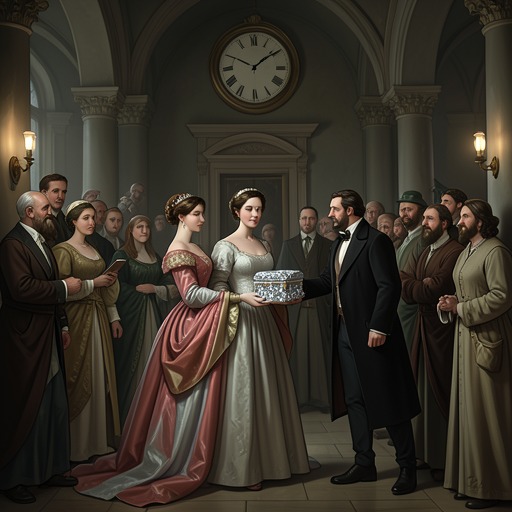
Hôtel de Ville, Paris
The Three MusketeersHôtel de Ville, Paris is presented as more than a municipal building: during the royal ball of La Merlaison, it becomes a carefully secured courtly stage on which civic display, royal ceremony, military authority, and political suspicion converge. Its festive magnificence offers a public surface for a dangerous private question—whether Queen Anne possesses all twelve of the diamond studs demanded by the king and scrutinized by Cardinal Richelieu.
Definition and Setting
The building is the venue chosen by the aldermen of Paris for a ball given to King Louis XIII and Queen Anne of Austria. The occasion centers on La Merlaison, the king’s favorite ballet, and preparations occupy eight days. City carpenters construct scaffolds for the invited ladies, the city grocer decorates the rooms with two hundred white-wax flambeaux, and twenty violins are engaged to play throughout the night at twice their customary price. The scale of the preparations turns the municipal interior into a temporary royal theater, joining urban administration to courtly spectacle.
The Hôtel de Ville also stands within the political atmosphere of Paris, a city accustomed to sudden panic and armed response. In the wider world of the novel, nobles, the king, the cardinal, Spain, robbers, Huguenots, wolves, and scoundrels are all described as forces making war upon one another. Against that background, a building prepared for music and ceremony remains inseparable from surveillance and factional power. The ball’s apparent brightness therefore rests upon an unstable civic and political landscape.
Security and Military Control
The preparations reveal that the Hôtel de Ville is treated as a controlled political site rather than merely a place of entertainment. At ten o’clock in the morning, Sieur de la Coste, an ensign in the king’s Guards, arrives with two officers and several archers and demands every key to the building’s rooms and offices. The registrar, Clement, hands over the keys immediately; each bears a ticket for identification, and de la Coste assumes responsibility for every door and avenue.
The security cordon expands as the day proceeds. At eleven o’clock, Duhallier, captain of the Guards, arrives with fifty archers and distributes them throughout the Hôtel de Ville at assigned entrances. At three o’clock, two companies of Guards appear, one French and one Swiss. The French company combines men from Duhallier’s force with men from M. Dessessart’s company. This precise timetable gives the building the character of a military deployment: the civic hall is mapped, its access points are assigned, and its ceremonial openness is bounded by armed authority.
The Royal Ball and Its Political Drama
The king reaches the Hôtel de Ville at midnight, traveling from the Louvre through streets illuminated by colored lanterns. The aldermen, dressed in cloth robes and preceded by six sergeants carrying flambeaux, meet him on the steps. The provost of the merchants delivers a speech of welcome, while Louis XIII apologizes for the late hour and attributes the delay to Cardinal Richelieu, who had detained him until eleven o’clock to discuss affairs of state. Even the king’s entrance thus carries the trace of the rivalry between royal ceremony and ministerial power.
The king arrives in full dress accompanied by prominent nobles and officers, yet observers notice that he looks dull and preoccupied. Madame la Première Présidente, the most important guest after the queen, has arrived earlier and is placed in a box opposite the one intended for Queen Anne. The king’s collation of preserves and other delicacies is prepared in a small room beside the church of Saint Jean, in front of the city’s silver buffet, which four archers guard. Every arrangement combines luxury with watchfulness.
The decisive tension concerns the queen’s diamond studs. Richelieu tells Louis XIII that if the queen possesses them, he should count them; if only ten are present, the king should ask who stole the two studs that are elsewhere. The king has no time to question the cardinal before the queen appears and draws universal admiration. Dressed in the costume of a huntress, with a beaver hat and blue feathers, gray-pearl velvet, blue satin embroidered with silver, and diamond clasps, she wears the studs on her left shoulder against a bow matching her plumes and petticoat.
The queen’s appearance reverses the emotional balance of the room. Louis XIII trembles with joy, while Richelieu is vexed. Because of their distance, neither can count the studs immediately; the public magnificence of the entrance intensifies rather than resolves the private uncertainty. The Hôtel de Ville therefore functions as a threshold between spectacle and exposure. A jewel arrangement that might otherwise be a detail of dress becomes a test of the queen’s political danger and of the king’s authority over her.
Civic Ceremony and Royal Power
The ball dramatizes the interdependence of the city and the monarchy. Paris’s aldermen provide the labor, lighting, music, hospitality, and formal welcome, but royal Guards control the building and its approaches. Municipal ceremonial language and military command occupy the same space. The Hôtel de Ville is consequently both a civic institution and an extension of the royal court for the night.
Its spatial organization makes power visible. The guests are placed in boxes, the queen and Madame la Première Présidente face one another, the king’s food is protected by archers, and every doorway is subject to military custody. The arrangement creates a system of observation in which rank, movement, and access are carefully managed. The building’s festive architecture does not conceal power; it choreographs it.
Narrative Significance
Hôtel de Ville, Paris concentrates the novel’s recurring contrast between public order and hidden conflict. The city celebrates a ballet while the monarchy investigates the queen; musicians, flambeaux, robes, and jewels suggest abundance, while keys, archers, guarded rooms, and military companies reveal fear. The site turns a ceremonial evening into a political examination conducted before a crowd.
The building’s importance lies in this conversion of civic space into dramatic pressure. At Hôtel de Ville, Paris, royal favor, the king’s suspicion, Richelieu’s hostility, Anne of Austria’s peril, and the consequences of the diamond mission meet in a single setting. The queen’s successful appearance momentarily defeats the cardinal’s expectation, but the question of the missing studs has already transformed celebration into evidence. The hall remains memorable as the place where pageantry does not dispel intrigue; it gives intrigue its most visible and dangerous stage.